
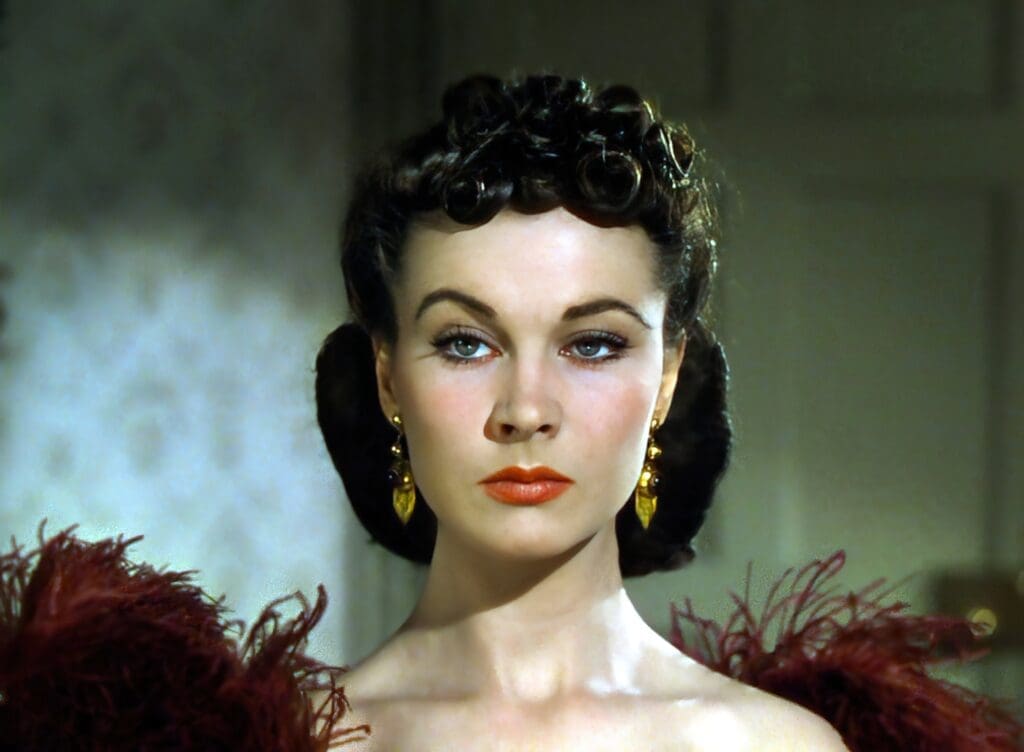
Of all the moments of courage in Gone with the Wind, perhaps the most stunning is the one in which Scarlett O’Hara walks into Ashley Wilkes’s birthday party knowing she will be judged — harshly, publicly, and without mercy.
It isn’t her idea. Despite Scarlett’s protests, Rhett has insisted not only that she attend, but that she wear her most vixen-coded dress. The gossip is already in full swirl: Ashley’s sister has told everyone about finding Scarlett and Ashley in an embrace. Scarlett walks in fully expecting to be shunned, humiliated. As she appears in her burgundy evening gown, the tension sharpens when her eyes meet Melanie’s. Will Melanie finally see Scarlett as everyone else does? Will she deliver the scathing rebuke the room is waiting for?
Vivien Leigh plays the moment exquisitely. The look on Scarlett’s face holds defiance and fear at the same time: chin lifted, eyes steady, mouth set just so. It’s the expression of someone forcing herself to endure what she cannot avoid.
What makes the scene unforgettable, though, isn’t simply how Scarlett looks, even though she is devastatingly beautiful, the embodiment of every wife’s worst nightmare. It’s what happens next.
Melanie, refusing to believe anything unkind about the friend she loves, goes to Scarlett first. She kisses her on the cheek, calls her “Scarlett darling,” compliments her lovely dress — and then asks her to help receive the guests, a role that publicly honors Scarlett above the rest of the room. With impeccable Southern manners, Melanie forces the partygoers to fall in line, greeting Scarlett not as a woman to be judged, but as one to be respected.
The Makeup Breakdown: Composure as Power
The makeup in this scene does deliberate, strategic work. It isn’t soft or girlish; it’s composed, controlled, and deliberately calibrated. It’s armor masquerading as beauty.
At first glance, Scarlett’s makeup looks simple — perhaps even restrained. But that restraint is precisely the point. Nothing about this face is accidental, and nothing is soft in a way that suggests vulnerability.
Scarlett’s Skin: Composed, Not Innocent
Scarlett’s complexion is porcelain, but not girlish. The finish is matte and even, carefully balanced to avoid obvious shine or overt warmth. There is blush present, but it’s applied with discipline — structured rather than blooming — reinforcing composure instead of emotional openness.
Earlier in the film, when Scarlett is young and intent on charming Ashley, she famously pinches her cheeks to force a rosy flush — a self-conscious performance of freshness meant to attract attention. Here, the effect is entirely different. The filmmakers allow just enough color for Scarlett to look capable of blushing — without ever letting her appear flustered.
In both the film’s 19th-century setting and its 1939 production context, too much visible blush would have suggested a woman advertising herself — a coded signal of impropriety rather than confidence. The restraint here is deliberate. Vivien Leigh’s Scarlett looks alive, but not undone.
Scarlett’s Brows: Framed Resolve
Her brows are beautifully shaped but firm — softly arched, clearly defined, and expressive without being dramatic. They anchor the face and give her eyes authority. There’s no softness here meant to charm; the brows telegraph resolve.
They frame the eyes not to entice, but to hold ground.
Scarlett’s Eyes: Steady, Unblinking
Scarlett’s eyes are the emotional center of the look. They’re lined to create clarity and presence, not seduction. The liner defines the shape without exaggeration, and the lashes frame the eyes just enough to draw attention, not enough to soften them.
The effect is striking: eyes that meet another’s gaze without wavering. Eyes that do not apologize.
Scarlett’s (Not Scarlet) Lips: Calibrated Defiance
Her lip color in this scene is often remembered as red — but it isn’t. It’s coral, and that distinction matters. A true red would have read as openly confrontational to a 1939 audience, especially on a woman already being scrutinized and judged. Red carried different cultural weight at the time, signaling overt sexuality or moral transgression in a way this scene carefully avoids.
Coral does something subtler. It sits between innocence and rebellion — bold enough to register on screen, restrained enough to remain socially acceptable. In a room primed to condemn her, the coral lip gives Scarlett presence without confirming the worst assumptions being made about her.
There’s also the practical reality of 1939 Technicolor filmmaking. Coral tones held their saturation under hot studio lights and photographed cleanly against pale skin, while deeper reds risked darkening or flattening on screen. The choice was aesthetic, yes, but also technical.
Most important, the lip mirrors Scarlett’s emotional posture in the scene. This isn’t a battle she’s choosing; it’s one she’s bracing herself to endure. The coral doesn’t shout. It holds.
The Overall Effect
Taken together, Scarlett’s makeup does something quietly brilliant. It allows her to walk into a hostile room without visibly cracking. It doesn’t soften her. It doesn’t plead. It endures.
That restraint becomes even more legible when set against Melanie’s appearance. Olivia de Havilland is styled to read as wholly unthreatening — her makeup pale, fresh, and Madonna-esque, her beauty gentle rather than declarative. Nothing about Melanie’s face competes for attention or power; it reassures. Where Scarlett’s composure is defensive, Melanie’s softness signals moral certainty.
The contrast sharpens the women’s opposing motivations: Scarlett enters armored in control, braced for judgment; Melanie, ever selfless, moves toward her without calculation, choosing loyalty over caution and generosity over self-protection.
In a room prepared to punish, Melanie’s mercy becomes its own kind of bravery.
Want more stories about classic glamour? Check out our post on Ella Fitzgerald.

+ Leave a comment
back to pretty